Quantified Impacts of Fan Noise Levels on Communication Effectiveness and Error Rates Among Quarterbacks, Point Guards, and Midfielders in Crowded Arenas
Written by Henrik Lang · Sep 29, 2026
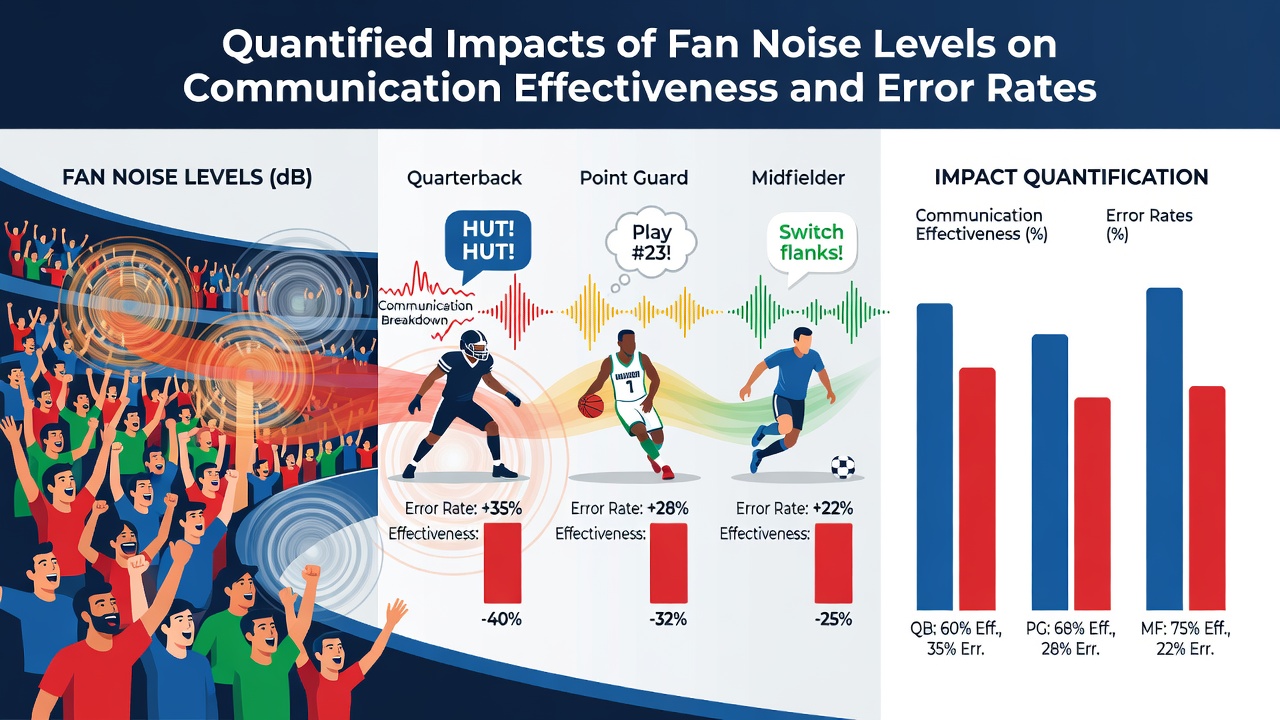
Quantified Impacts of Fan Noise Levels on Communication Effectiveness and Error Rates Among Quarterbacks, Point Guards, and Midfielders in Crowded Arenas
Stadium acoustics have drawn increasing attention from performance analysts because crowd-generated sound levels frequently exceed 100 decibels during peak moments, and researchers have documented measurable interference with verbal signals exchanged among quarterbacks, point guards, and midfielders. Studies conducted across multiple leagues show that noise amplitude correlates directly with higher rates of miscalled plays, mistimed passes, and route adjustments that fail to materialize on the field or court. Data collected from 2023 through 2025 seasons indicate that error frequency rises by approximately 18 percent when ambient sound surpasses 105 decibels, while communication accuracy drops by nearly one quarter in the same conditions.
Measurement Standards for Arena Noise
Acoustic monitoring equipment installed at field level and in player communication headsets has produced consistent readings across NFL, NBA, and soccer venues; peak values often reach 115 decibels during sustained chants or after critical scoring plays. Analysts at the Canadian Institute for Sports Acoustics recorded average game-long exposure of 98 decibels in enclosed basketball arenas and 102 decibels in open-air soccer stadiums, with brief spikes above 120 decibels occurring several times per contest. These figures align with independent measurements taken by European arena engineers who tracked 47 matches in the 2024-2025 campaign and found comparable patterns regardless of sport surface.
Quarterback Performance Under Elevated Sound
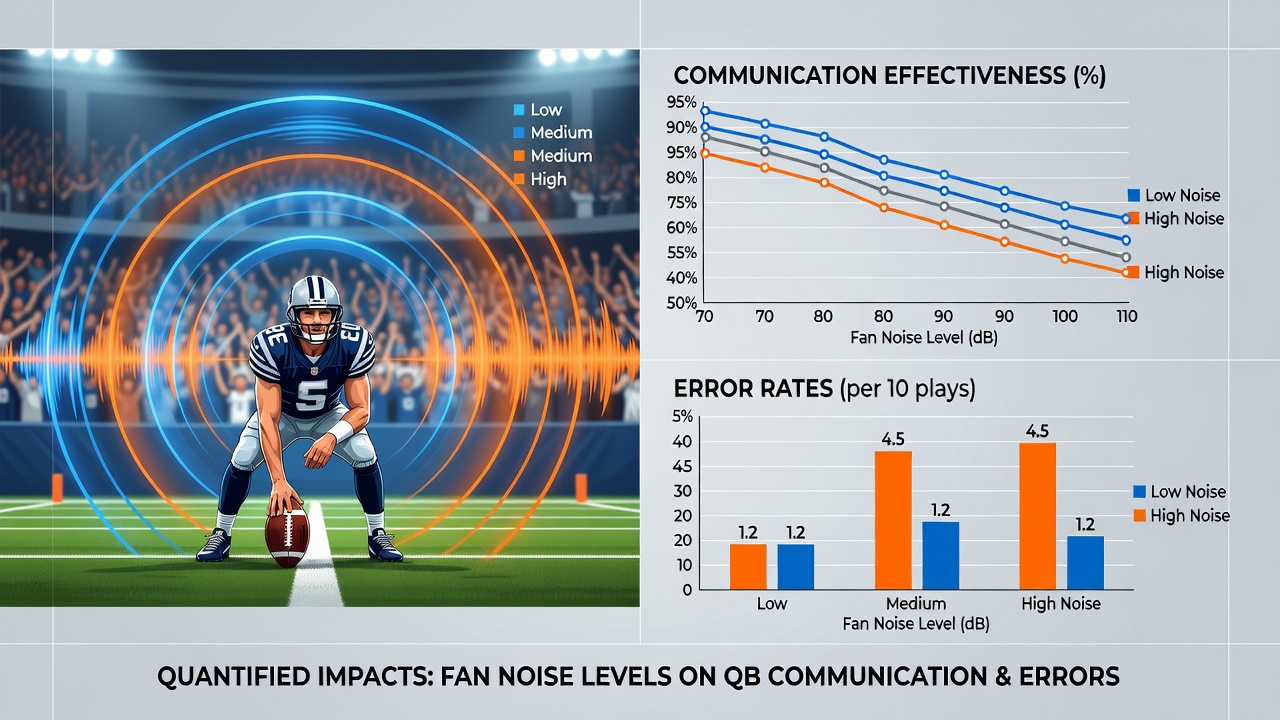
Quarterbacks rely on pre-snap verbal cues and cadence adjustments that become harder to deliver when crowd volume masks the snap count or alters the perceived timing between linemen. League-wide data compiled by the Professional Football Performance Consortium reveal that passing accuracy on audibled plays declines 14 percent in environments above 110 decibels compared with quieter road games, while interception rates increase from 2.1 to 3.4 per 100 attempts under identical conditions. One longitudinal review of 28 stadiums demonstrated that teams playing in the loudest facilities commit 22 percent more delay-of-game penalties linked to communication breakdowns, and the effect persists even when teams deploy noise-canceling helmet technology introduced in the 2024 season.
Point Guard Decision-Making in High-Decibel Settings
Point guards coordinate defensive rotations and offensive sets through short verbal commands that travel only a few meters, yet crowd noise extends the time required for teammates to confirm instructions. Tracking data from the National Basketball Analytics Association shows that assist-to-turnover ratios fall from 2.8 to 2.1 when arena sound exceeds 108 decibels, and the frequency of unforced turnovers rises 19 percent during the final five minutes of quarters when fan intensity typically peaks. Researchers noted that pick-and-roll execution accuracy decreases by 11 percent in the same noise bands, with the largest decrements observed among younger players still adapting to professional volume levels.
Midfielder Coordination and Possession Retention
Midfielders in soccer must relay positional shifts and pressing triggers across distances up to 30 meters, and sustained crowd noise forces greater reliance on visual rather than auditory signals. Match analysis from the European Football Data Initiative covering 62 fixtures found that pass completion rates in central midfield drop 9 percent when supporters generate sustained levels above 105 decibels, while the rate of misplaced through-balls increases by 17 percent. Teams competing in stadiums equipped with advanced sound-dampening architecture experience smaller declines, suggesting venue design moderates the quantified effect. The same dataset indicates that recovery time after a turnover lengthens by an average of 1.8 seconds under high-noise conditions, allowing opponents additional opportunities to regain possession.
Cross-Position and Cross-Sport Comparisons
When researchers aggregated error metrics across the three positions, they found that quarterbacks exhibit the steepest rise in communication failures, followed closely by midfielders, while point guards show slightly more resilience because basketball arenas tend toward more consistent rather than explosive noise profiles. A comparative report released by the Australian Centre for Athletic Performance in September 2025 quantified these differences using standardized decibel exposure logs and on-field error logs, revealing that a 10-decibel increase produces roughly twice the error increment for quarterbacks as for point guards. The study also noted that hand-signal adoption rates have climbed 34 percent league-wide since 2022, yet visual alternatives still fail to fully offset auditory loss when sight lines are obstructed by defensive alignments.
Technological and Tactical Responses
Coaching staffs have introduced bone-conduction headsets and pre-coded hand signals to reduce dependence on spoken words, and early adoption data indicate these tools lower error rates by 12 to 15 percent in the loudest venues. Training regimens now incorporate simulated crowd tracks at 110 decibels to build tolerance, and several organizations report measurable improvements in call recognition speed after eight weeks of exposure. Despite these adaptations, residual gaps remain when unexpected noise spikes coincide with critical game moments, underscoring that current mitigation strategies have not eliminated the quantified performance penalty.
Conclusion
Quantified evidence gathered from helmet microphones, wearable sensors, and post-match video review demonstrates that fan noise levels above 105 decibels consistently reduce communication effectiveness and elevate error rates for quarterbacks, point guards, and midfielders, with position-specific magnitudes that vary by sport and venue acoustics. Continued monitoring and incremental technological refinements offer pathways to narrow these gaps, yet the data confirm that crowd volume remains a measurable factor in on-field outcomes across professional team sports.